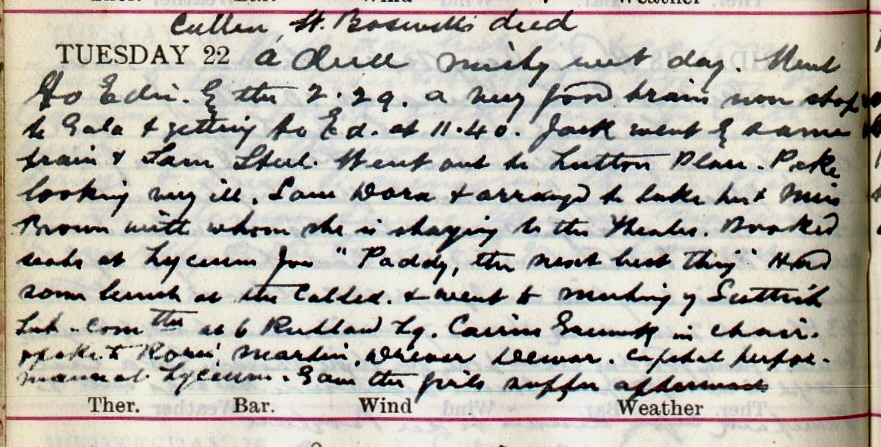
22 November 1921 diary of Dr John Stewart Muir (1845-1938) of Selkirk

Cullen, St Boswells1, died

A dull Misty wet day. Went to Edinburgh by the 2.29, a very good train non stop to Gala, + getting to Ed. at 11.402. Jack3 went on same train + Sam Steel4. Went out to Lutton Place5. Pike6 looking very ill. Saw Dora7 + arranged to take her + Miss Brown8 with whom she is staying to the theatre. Booked seats at the Lyceum for “Paddy the Next Best Thing9. Had some lunch at the Called.10 + went to meeting of the Scottish Sub-Comttee11 at 6 Rutland Square. Cairns, Greenock12, in chair. Spoke to Rorie13, Martin14, Drever15, Dewar16. Capital performance at Lyceum17. Gave the girls supper afterwards.

1 William Laing Cullen (1861-1921), M.D., medical practitioner, of Fairholme, St Boswells, had died on 22 November 1921, aged 60

2 The Editor finds it difficult to believe that Selkirk to Edinburgh by train took 9 hours; one can now do that journey by bus and train from Selkirk in less than an hour and a half and modern rail services were hardly faster than their Victorian predecessors until the latest generation of lighter trains was introduced recently after which acceleration out of stations increased dramatically

3 John ‘Jack’ Roberts junior (1876-1966), mill owner, husband of Agnes Amelia ‘Nancy’ Roberts née Muir and thus Dr Muir’s son-in-law

4 Samuel ‘Sam’ Strang Steel (1882-1961), 1st Baronet, M.P., J.P., T.D., Lord Lieutenant of Selkirk 1948-1958

5 Lutton Place, Newington, Edinburgh home of Frederick and Jean Pike

6 Frederick Charles Pike (1883-1921), theatrical agent, had married Dr Muir’s daughter Jane Henderson Logan ‘Jean’ Muir in 1920 but was gravely ill by this time

7 Andrina Dorothy ‘Dora’ Muir (1882-1978), nurse and Dr Muir’s youngest daughter

8 It may be possible to identify Miss Brown when the 1921 Census is published early next year

9 ‘Paddy the Next Best Thing’ a 1908 romantic comedy novel by the British writer Gertrude Page; this will have been an adaptation for the theatre because the film versions documented online were not released until 1923 (British silent adaptation) and 1933 (American adaptation) respectively

10 The Called. is presumably the Caledonian Hotel at the junction of Princes Street and Rutland Street, very much on Dr Muir’s way to Rutland Square in Edinburgh’s West End

11 The British Medical Association (B.M.A.); the meeting appears to be at the premises of T S Paterson & Davidson W.S. [1925 Valuation Roll, VR010000495-/3, Edinburgh Burgh, page 3 of 249] but house numbers are unreliable so this is a cautious identification

1 Dr Cairns is not yet identified

13 Perhaps Dr Frank Miller Rorie (1895-1949), medical practitioner, of Alford Place, later Albyn Place, both Aberdeen [1925 Valuation Roll, VR008600096-/376, Aberdeen Burgh, page 376 of 1047; birth, 1895, 405/ 115, Auchterderran; death, 1949, 168/2 604, Aberdeen Southern District]

14 There were at least five doctors with the surname Martin in Scotland at this time so without recourse to the B.M.A. records it is impossible to identify this individual

15 James Richan Drever (1873-1956), medical practitioner and administrator, M.A., M.B., F.R.C.P.Ed., born Alexandria, West Dunbartonshire, M.A., 1893, M.B., C.M. (Glasgow), 1906, Scottish Medical Secretary of the B.M.A., 1919- [“J. R. Drever, M.A., M.B., F.R.C.P.Ed. Late Scottish Medical Secretary, British Medical Association.” The British Medical Journal, vol. 1, no. 3772, BMJ, 1933, pp. 725–26, http://www.jstor.org/stable/25351306.%5D

16 There were at least nine doctors with the surname Dewar in Scotland at this time so without recourse to the B.M.A. records it is impossible to identify this individual

17 The Royal Lyceum Theatre, Grindlay Street, Edinburgh [Canmore ID 106416], adjacent to the Usher Hall and not far from the Caledonian Hotel; Dr Muir has planned his day carefully
[Source: Scottish Borders Archives & Local History Service SBA/657/24, Dr J S Muir of Selkirk, medical practitioner, journal for 1921]
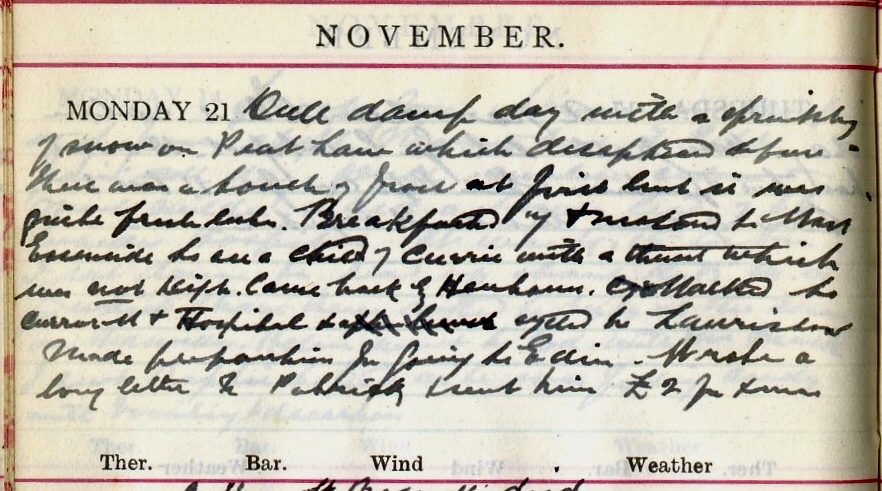
21 November 1921 diary of Dr John Stewart Muir (1845-1938) of Selkirk

Dull damp day with a sprinkling fog snow on Peat Law1 which disappeared after. There was a touch of frost at first but it was quite fresh later. Breakfasted 7 [sic] + motored to West Essenside2 to see a child of Currie3 with a throat which was not Diph.4 Came back by Henhouse5. Cyc Walked to Curror Street + Hospital6 + after lunch cycled to Lauriston7. Made preparations for going to Edin.8 Wrote a long letter to Patrick9 + sent him £2 for Xmas.

1 Peat Law, 426.0 m, grid reference NGR NT334,267, above Yarrow Feus and Catslackburn

2 Wester Essenside, Ashkirk was home of the Currie and Heard families, both referred to in Dr Muir’s diaries

3 Walter ‘Walt’ Currie (fl.1921), ploughman, inhabitant occupier not rated at a house at Wester Essenside, Ashkirk [1920 and 1921 Valuation Rolls 1921 VR011700009-/303, Selkirk County, page 303 of 611]

4 There had been a prolonged outbreak of Diphtheria and Scarlet Fever in the Selkirk area from earlier in 1921 and extending into the following year

5 Henhouse, Selkirk, NT469,271, adjacent to the Haining Estate

6 In the case is is assumed that Dr Muir is referring to the partnership’s Hospital at Mauldsheugh rather than the Infectious Diseases Hospital out by the Selkirk Hills

7 Lauriston, Philiphaugh, Selkirk, was home of Katie Smith née Locke (about 1854-1934), widow of Thomas Smith, tweed manufacturer, and some of her (adult) children

8 Dr Muir was to have a busy day in Edinburgh the following day, see diary entry for 22 November 1921

9 Patrick Rodger Stewart ‘Pat’ Muir (1879-1961), Dr Muir’s only son, living in New Zealand since 1902

[Source: Scottish Borders Archives & Local History Service SBA/657/24, Dr J S Muir of Selkirk, medical practitioner, journal for 1921]
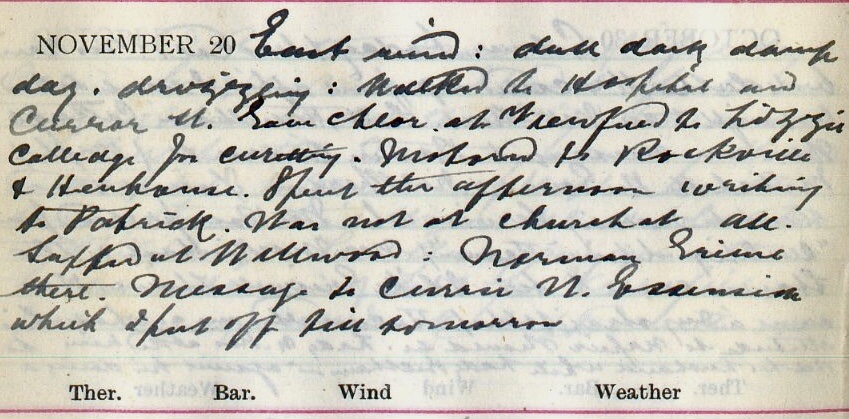
20 November 1921 diary of Dr John Stewart Muir (1845-1938) of Selkirk

East wind: dull dark damp day. Drizzling: Walked to Hospital + Curror Street. Gave Chlor[oform] at Viewfield at Lizzie Colledge1 for curetting. Motored to Rockville2 + Henhouse3. Spent the afternoon writing to Patrick4. Was not at church at all. Supped at Wellwood5. Norman Grieve there6. Message to Walter Currie7, Wester Essenside which I put off till tomorrow.

1 Elizabeth ‘Lizzie’ Colledge née Darling (about 1838-1925), wife of Thomas Colledge; they had married 1857 at Lauder

2 Robert Currie ‘junior’ (about 1847-1923), hosiery manufacturer, of Rockville, Selkirk; the fourth of five generations at Selkirk with the given name Robert

3 Henhouse on the edge of the Haining estate could imply visiting a number of households

4 Patrick Rodger Stewart ‘Pat’ Muir (1879-1961), Dr Muir’s only son, living in New Zealand since 1902

5 Wellwood, Ettrick Terrace, Selkirk, home of John ‘Jack’ Roberts junior (1876-1966), his wife Agnes Amelia ‘Nancy’ Roberts née Muir (1878-1948) and their five children, Dr Muir’s grandchildren

6 Norman William Grieve (1852-1936), Hawick-born, worked in tropical agriculture and as the director of public companies (rubber and tea businesses according to Douglas Scott in ‘A Hawick Word Book’) and left £308,574

7 Walter Currie, ploughman, was Inhabitant Occupier not rated of a house at Wester Essenside, Ashkirk [1921 Valuation Roll, VR011700009-/303, Selkirk County, page 303 of 611]

[Source: Scottish Borders Archives & Local History Service SBA/657/24, Dr J S Muir of Selkirk, medical practitioner, journal for 1921]
1 x

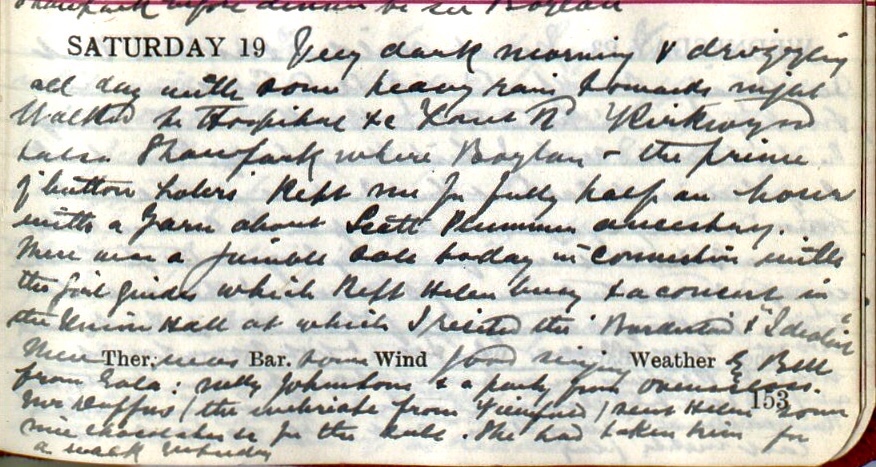
19 November 1921 diary of Dr John Stewart Muir (1845-1938) of Selkirk

Very dark morning + drizzling all day with some heavy rain towards night. Walked to Hospital +c Forest Road, Kirkwynd + also Shawpark where Boylan1 – the prince of button holers – kept me fully half an hour with a yarn about Scott Plummer’s2 ancestry. There was a jumble sale today in connection with the Girl Guides which kept Helen3 busy + a concert in the Union Hall at which I recited the ‘Borderland’4 + ‘Idealist’5. There was some good singing by Bell of Gala6. Mr Duffus7 (the inebriate from Viewfield) sent Helen some nice chocolates +c for the sale. She had taken him for a walk yesterday.

1 John Dun Boylan (1850-1924), civil engineer, acquaintance of Dr Muir, sometime of Shawmount and Shawpark, Selkirk

2 Charles Henry Scott Plummer (1859-1948), J.P.; Lord-Lieutenant, of Middlestead and Sunderland Hall

3 Helen Frances ‘Mousey’ Muir (1880-1963), Dr Muir’s third daughter and sometime housekeeper

4 The ballad or poem Borderland has not been identified

5 The ballad ‘The Idealist’ is probably the short ballad about a louse by Robert W Service (1874-1958), ‘The Bard of the Yukon’ but of Scots descent and educated there, which starts “Oh you who have daring deeds to tell! | And you who have felt Ambition’s spell!”

6 Bell of Gala appears occasionally in Dr Muir’s diaries, he is not yet identified

7 Mr Duffus has not been identified but Dr Muir’s diary entry for 27 November 1921 notes that he is from Aberdeen

[Source: Scottish Borders Archives & Local History Service SBA/657/24, Dr J S Muir of Selkirk, medical practitioner, journal for 1921]
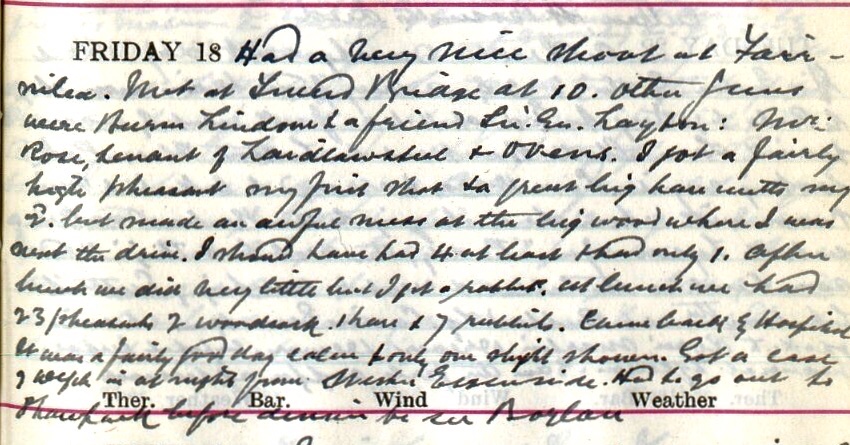
18 November 1921 diary of Dr John Stewart Muir (1845-1938) of Selkirk

Had a very nice shoot at Fairnilea. Met at Tweed Bridge at 10. Other guns were Burns Lindow1 + a friend Sir Geo. Layton2: Mr Rose3, tenant of Laidlawstiel + Ovens4. I got a fairly high pheasant my first shot + a great big hare with my 2nd but made an awful miss at the great wood where I was next the drive. I should have had 4 at least + had only 1. After lunch we did very little but I got a rabbit. At lunch we had 23 pheasants, 2 woodcock, 1 hare + 7 rabbits. Came back by Hospital. It was a fairly good day, calm + only some slight showers. Got a case of Diph. in at night from Wester Essenside5. Had to go out to Shawpark before dinner to see Boylan6.

1 Isaac William Burns-Lindow (about 1868-1946), D.S.O., army officer and the last commanding officer of The South Irish Horse, one of the six southern Irish regiments of the British Army disbanded in 1922 following the creation of the new Irish Free State

2 Sir George Layton has not been readily identified

3 Nobody called Rose (or Ross) is recorded as tenant in the Valuation Rolls so one can only assume that this was a short-term let rather than a tenancy; the Proprietor of Laidlawsteel [or Laidlawstiel], Caddonfoot at this time was Elinor Frances Mitchell, widow, and the Tenant was Andrew George Dun [1921 Valuation Roll, VR011700009-/305, Selkirk County, page 305 of 611]

4 Assume William Roberts Ovens (1846-1936) or his son William Roberts Ovens junior (1889-1952), less probably Adam Beattie Ovens (1891-1962) though the sons did jointly hold the shootings and fishings at Ashiestiel during the First World War

5 Wester Essenside, Ashkirk was home of the Currie and Heard families, both referred to in Dr Muir’s diaries

6 John Dun Boylan (1850-1924), civil engineer, acquaintance of Dr Muir, sometime of Shawmount and Shawpark, Selkirk

[Source: Scottish Borders Archives & Local History Service SBA/657/24, Dr J S Muir of Selkirk, medical practitioner, journal for 1921]
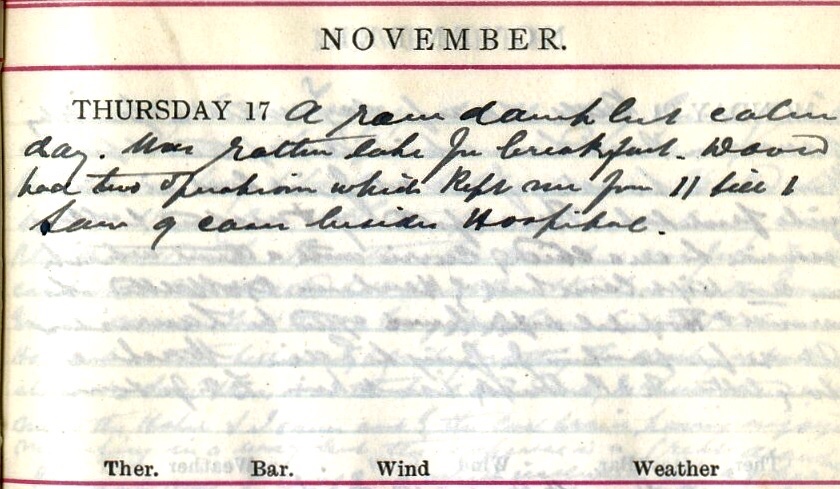
17 November 1921 diary of Dr John Stewart Muir (1845-1938) of Selkirk

A raw damp but calm day. Was rather late for breakfast. David1 had two operations which kept me from 11 to 1. Saw 9 cases besides Hospital2.

1 David Charteris ‘Dav.’ Graham (1889-1963), M.B., medical practitioner and Dr Muir’s business partner

2 The operations would have been at Mauldsheugh and it is likely that this also refers to Mauldsheugh, which functioned as the Muir & Graham partnership’s hospital (as opposed to its Viewfield Nursing Home), but caution is needed because Dr Muir seems to have used the word Hospital interchangeably for Mauldsheugh property and for the Infectious Diseases Hospital at the north end of the Selkirk Hills

[Source: Scottish Borders Archives & Local History Service SBA/657/24, Dr J S Muir of Selkirk, medical practitioner, journal for 1921]
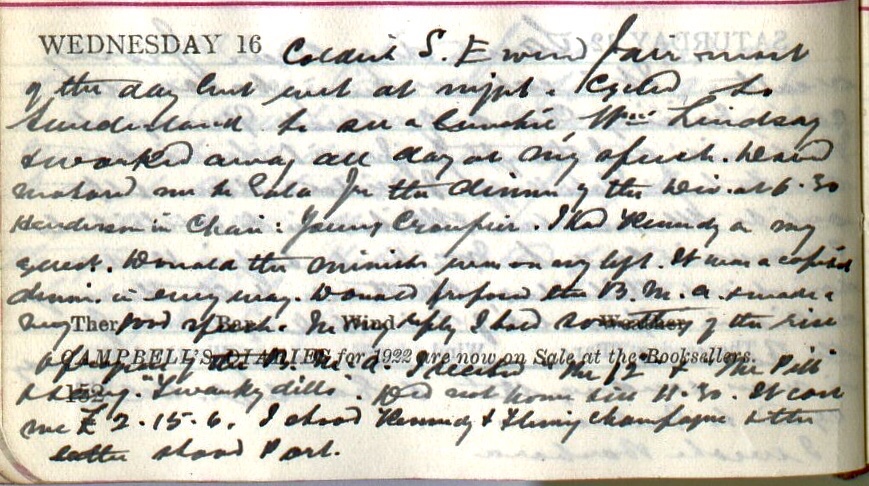
16 November 1921 diary of Dr John Stewart Muir (1845-1938) of Selkirk

Coldish S.E. wind for most of the day but wet at night. Cycled to Sunderland to see a lunatic, Wm [?] Lindsay1 + worked away all day at my speech. David2 motored me over to Gala for the dinner of the Div. [Division3] at 6.30. Henderson4 in chair: Young5 [was] Croupier. I had Kennedy6 as my guest. Donald7 the minister was on my left. It was a capital dinner in every way. Donald proposed the B.M.A. + made a very good speech. I recited ‘The 12th’8 + ‘The Pill’9 + sang “Twanky Dillo”10. Did not leave till 11.30. I stood Kennedy + Fleming11 champagne + the latter stood port.

1 Perhaps William Lindsay, woodcutter, who was Occupier of a house at Sunderland, Selkirk [1921 Valuation Roll, VR011700009-/327, Selkirk County, page 327 of 611]

2 David Charteris ‘Dav.’ Graham (1889-1963), M.B., medical practitioner and Dr Muir’s business partner

3 This appears to be the Borders Division of the Edinburgh Branch of the British Medical Association

4 Percy James Henderson (1871-1935), M.B., CM (Ed.), 1896, medical practitioner, at Church Street, Galashiels in 1920

5 Dr Young is presumably the same medic as the one referred to in Dr Muir’s diary entry of Wednesday 14 July 1915 “… to South Common, Ashkirk, Lilliesleaf & Newtown where I attended a meeting of the War Committee of the Div. Blair, Young, Oliver & myself.”; perhaps Dr John Young (1858-1934), M.B., C.M., medical practitioner, of The Thorn, Earlston [sources: Proprietor Occupier, Thorn House, Earlston, 1920 Valuation Roll, VR009; birth, 1858, 795/ 21, Lilliesleaf; death, 1934, 685/6 515, Newington]

6 This is likely to be William Nicol Watson Kennedy (1888-1961), M.D., D.P.H., Medical Officer of Health and School Medical Officer for Selkirkshire, 1921-about 1924

7 Probably the Reverend George Henry Donald (fl.1921), M.A., D.D., at this time at Galashiels, previously at Southdean, Hawick [Sources: 1921 Valuation Roll, VR003500014-/243, Galashiels Burgh, page 243 of 473 and 1903 Valuation Roll, VR011600026-/192, Roxburgh County, page 192 of 897]

9 Dr Muir’s recital ‘The Pill’ is from ‘Fancies of a Physician, Medical and Otherwise, in Scots and English’, Brown Son & Ferguson, Glasgow, 1938 by Dr John Freeland Fergus (1865-1943) [see also Mason, Sir David and James Beaton. “The Fergus Family and the Scottish Royal Colleges.” Scottish Medical Journal, vol. 54, issue. 2, RSMSMJ, 2009, pp. 48–51, https://doi.org/10.1258/rsmsmj.54.2.48.%5D

8 Dr Muir’s recital ‘The 12th’ has not been identified

10 Twanky Dillo or Twankydillo, ‘The Blacksmith’s Song’ “Here’s a health to the jolly blacksmith …”; a very ribald song in its bawdiest iterations (though the text has been confused by attempts to bowdlerise it) and it is definitely not Scots in origin with versions recorded in the south of England, notably Sussex and Dorset [see disussion here: Meaning of Twanky Dillo]

11 Assume Alexander Dickson Fleming (1865-1955), M.B., Ch.B. (Edin.), medical practitioner, physician at Kelso Dispensary and Medical Officer to Kelso Union

[Source: Scottish Borders Archives & Local History Service SBA/657/24, Dr J S Muir of Selkirk, medical practitioner, journal for 1921]
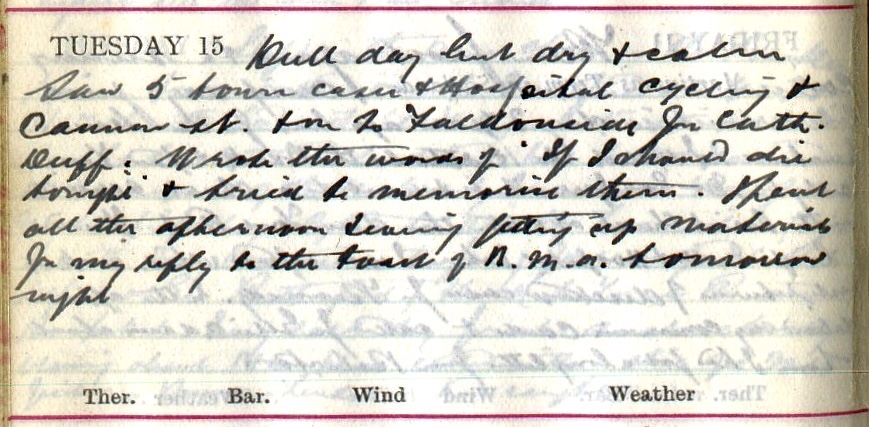
15 November 1921 diary of Dr John Stewart Muir (1845-1938) of Selkirk

Dull day but dry + calm. Saw 5 town cases + Hospital cycling + Cannon Street + on to Faldonside for Cath Duff1. Wrote the words of “If I Should Die Tonight”2 + tried to memorise them. Spent all the afternoon + evening getting up material for my reply to the toast of B.M.A. tomorrow night3.

1 Cath Duff is not identified, perhaps a member of staff

2 This probably refers to the poem by Thomas Gray “If I should die and leave you | Be not like the others, quick undone | Who keep long vigils by the silent | dust and weep. For my sake turn to life and smile | Nerving thy heart and trembling | hand to comfort weaker souls than thee. | Complete these unfinished tasks of mine | And I perchance may therein comfort thee.”

3 Dr Muir was at a British Medical Association event the following day, see his diary entry for 16 November 1921

[Source: Scottish Borders Archives & Local History Service SBA/657/24, Dr J S Muir of Selkirk, medical practitioner, journal for 1921]
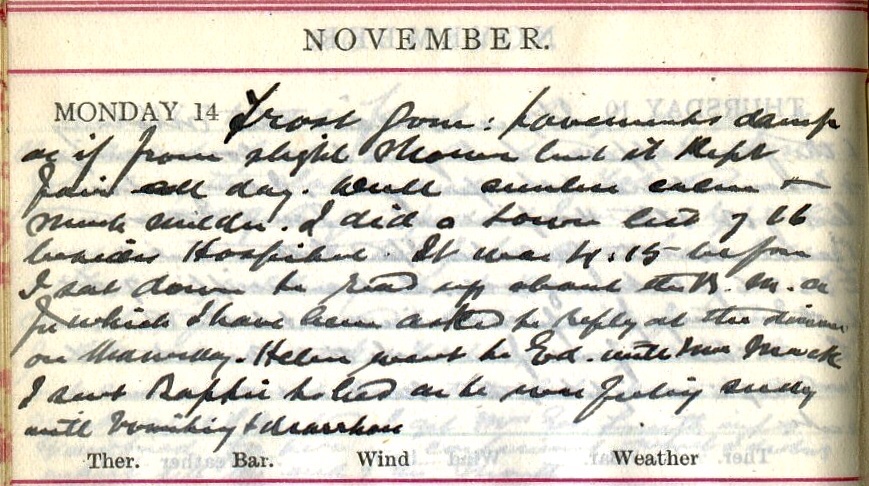
14 November 1921 diary of Dr John Stewart Muir (1845-1938) of Selkirk

Frost gone: pavements damp as if from slight showers but it kept fair all day. Dull sunless calm + much milder. I did a town list of 16 besides Hospital. It was 4.15 before I sat down to read up about the B.M.A. for which I have been asked to reply at the dinner on Wednesday1. Helen2 went to Ed. with Mrs Mack3. I sent Baptie4 to bed as he was feeling seedy with vomiting + diarrhoea.

1 Dr Muir was at a British Medical Association event the following Wednesday, see his diary entry for 16 November 1921

2 Helen Frances ‘Mousey’ Muir (1880-1963), Dr Muir’s third daughter and sometime housekeeper

3 Agnes Mackintosh, née Watson, formerly Harper (1859-1946), of Elm Park, Selkirk

4 Thomas Baptie (1860-1929), driver and handyman for Dr Muir

[Source: Scottish Borders Archives & Local History Service SBA/657/24, Dr J S Muir of Selkirk, medical practitioner, journal for 1921]

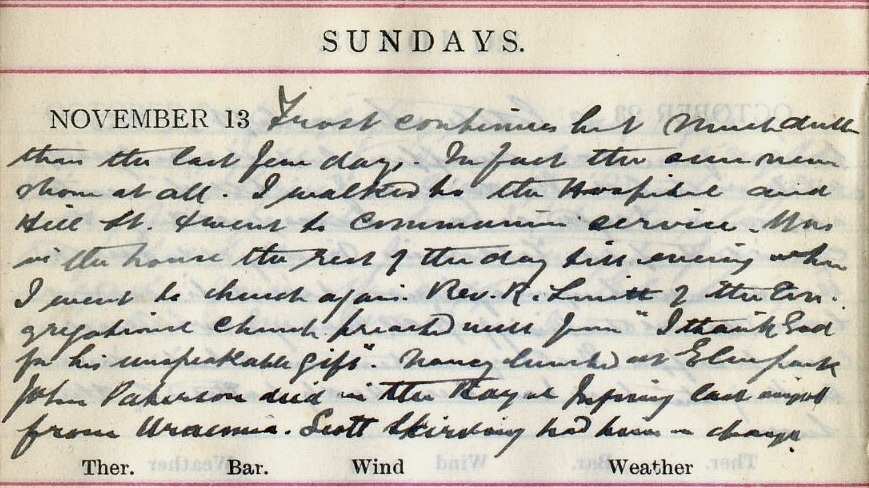
13 November 1921 diary of Dr John Stewart Muir (1845-1938) of Selkirk

Frost continues but much duller than the last few days. In fact the sun never shone at all. I walked to the Hospital + Hill Street + went to communion service. I was in the house the rest of the day till evening when I went to church again. Rev. R Smith1 of the Congregational Church preached well on “I thank God for his unspeakable gift”2. Nancy3 lunched at Elmpark4. John Paterson5 died in the Royal Infirmary last night from Uraemia. Scott Skirving6 had been in charge.

1 The Reverend Richard Smith, minister of Philiphaugh Congregational Church, and of the Manse, Russell Place, Selkirk

2 “Thanks be unto God for his unspeakable gift.” 2 Corinthians 9:15

3 Agnes Amelia ‘Nancy’ Roberts née Muir (1878-1948), Dr Muir’s second daughter

4 Elmpark, Selkirk was the home of Agnes Mackintosh née Watson, formerly Harper (1859-1946)

5 John Paterson, joiner, widower of Christina Cockburn, died 13 November 1921, aged 69, at the Royal Infirmary, Edinburgh, usual residence 5 Goslaw Green, Selkirk, of “Retention of urine 1 day” and “Uraemia 3 days” but Enlarged Prostate and Nephritis both “eight years”; he was the son of William Paterson, tweed mill worker and stockingmaker, and Helen Paterson née Kilpatrick

6 Archibald Adam Scott Skirving (1869-1930), M.B., C.M., lecturer in Clinical Surgery, Royal Edinburgh Infirmary

[Source: Scottish Borders Archives & Local History Service SBA/657/24, Dr J S Muir of Selkirk, medical practitioner, journal for 1921]