4 March 1919 diary of Dr John Stewart Muir (1845-1938) of Selkirk

About the keenest frost of the winter. Ice floating down the river. Cloudless sky + quite calm. A lovely day for movement but infernally cold all the same! Cycled in the town + to Bowhill + Hawkshaw1 (only I didn’t get so far as I met Annie2 near Rabbithall3) = 12 [?] + after tea to Briarbank = 19.35. D [Dr David Graham] at Lewenshope. I am afraid he is smelling about after Mrs Mackintosh’s Wolsley.

1 Hawkshaw or Hawkshawhall, Kirkhope, grid reference NGR 376242, see Ordnance Survey six inch Selkirkshire Sheet XV, published 1863

2 Ann Helen ‘Annie’ Little (1894-1968) of Hawkshaw, Kirkhope, Selkirkshire, Dr Muir’s much-appreciated servant for 6½ years until early 1918 when she left go to Moffat Hydro Military Hospital on V.A.D. work

3 Rabbithall Plantation, Kirkhope, grid reference NT383240, see Ordnance Survey six inch Selkirkshire Sheet XV, published 1863

[Source: Scottish Borders Archives & Local History Service SBA/657/22, Dr J S Muir of Selkirk, medical practitioner, journal for 1919]

3 March 1919 diary of Dr John Stewart Muir (1845-1938) of Selkirk

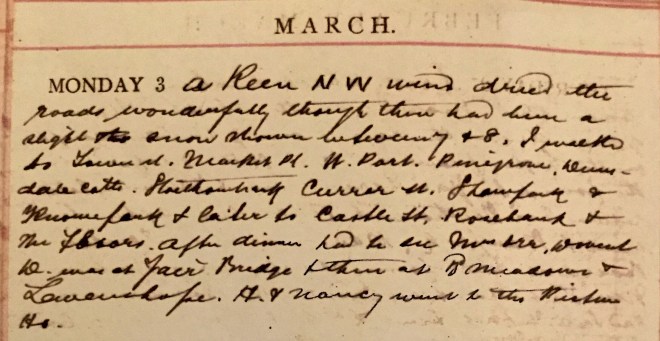
A keen NW wind dried the roads wonderfully though there had been a slight snow shower between 7 + 8. I walked to Tower Street, Market Place, West Port, Pinegrove, Dunsdale Cottages, Sloethornbank, Curror Street, Shawpark + Knowepark [?] or Thornepark [?] + later to Castle Street, Rosebank + the Floors. After dinner had to see Mrs Orr, Dovecot. D [Dr David Graham] was at Yair Bridge + then at Broadmeadows + Lewenshope. H + Nancy1 went to the Picture House.

1 Agnes Amelia ‘Nancy’ Roberts née Muir (1878-1948) and Helen Frances ‘Mousey’ Muir (1880-1963), Dr Muir’s second and third daughters

[Source: Scottish Borders Archives & Local History Service SBA/657/22, Dr J S Muir of Selkirk, medical practitioner, journal for 1919]

2 March 1919 diary of Dr John Stewart Muir (1845-1938) of Selkirk

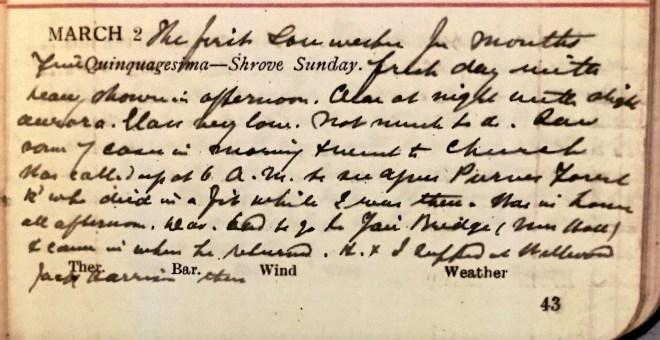
The first Sou Wester for months. Fine fresh day with heavy showers in afternoon. Clear at night with slight aurora. Glass very low. Not much to do. Saw saw [sic] 7 cases in morning + went to Church. Was called up at 6 a.m. to see Agnes Purves, Forest Road who died in a fit while I was there1. Was in town all afternoon. Dav [Dr David Graham] had to go to Yair Bridge (Miss Hall) + came in when he returned. H [Helen Muir] + I supped at Wellwood, Jack Harrison there.

1 Agnes Park Purves, law clerk and typist, daughter of John Dove Purves, deceased, manager of typewriter company, and Barbara Purves née Walker, died at 6.30 a.m. on 2 March 1919 at 113 Forest Road, Selkirk, aged 16, of influenza and pneumonia “six days”, certified by John S Muir, informant Adam Purves (uncle), of 3 Market Street, Galashiels, death registered 3 March 1919 at Selkirk, William Fowler, registrar

[Source: Scottish Borders Archives & Local History Service SBA/657/22, Dr J S Muir of Selkirk, medical practitioner, journal for 1919]

1 March 1919 diary of Dr John Stewart Muir (1845-1938) of Selkirk

Frost during night: a dull gradually becoming milder day. Calm S.W. Roads awful. D [Dr David Graham] went to Edin. I worked steadily from 9.45 till 7.45 with 3/4 h [three quarters of an hour] for tea. Agnes Purvis, Forest Road very ill with pneumonia 1: Malkie ? also. Made 22 town visits walking + motoring + also did Synton Mill, Shawpark, Old Broadmeadows + Yarrowford. At 7 had to go to Thornfield to see Charlie Roberts’ cook, Mrs Hook.

1 Agnes Park Purves (about 1903-1919), law clerk and typist, see entry for 2 March 1919

[Source: Scottish Borders Archives & Local History Service SBA/657/22, Dr J S Muir of Selkirk, medical practitioner, journal for 1919]

28 February 1919 diary of Dr John Stewart Muir (1845-1938) of Selkirk

Sharp frost: clear sunny day. Roads very soft in sun. No wind. Made 20 town visits (partly cycling) + gave Chlor[oform] for D [Dr David Graham] to currette Mrs Hardie, Castle Street1 . Helen spent the day with Mrs And. [Andrew] Linton [?] at Gilmanscleuch2 + went up + down in the car. She also called for Annie Little at Hawkshaw3 . Dav. Was at Yarrowford, Shaws + Deloraine.

1 Probably Mary Hardie née Morrison

2 Victoria Winona Linton née Johnstone (c.1883-), of Chapelhope, Ettrick; she had married Andrew Linton, farmer and agriculturalist, on 10 September 1917 at the North British Hotel, Edinburgh

3 Ann Helen ‘Annie’ Little (1894-1968) of Hawkshaw, Kirkhope, Selkirkshire, Dr Muir’s servant for 6½ years until early 1918 when she left go to Moffat Hydro Military Hospital on V.A.D. work

[Source: Scottish Borders Archives & Local History Service SBA/657/22, Dr J S Muir of Selkirk, medical practitioner, journal for 1919]

27 February 1919 diary of Dr John Stewart Muir (1845-1938) of Selkirk

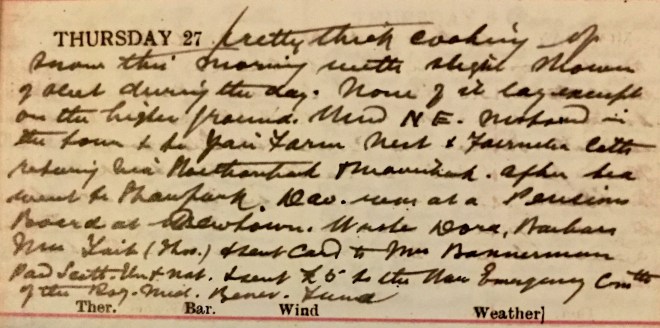
Pretty thick coating of snow this morning with slight showers of sleet during the day. None of it lay except on the higher ground. Wind N.E. Motored in the town + to Yair Farm, Nest + Fairnilee Cottages returning via Sloethornbank + Mavisbank. After tea went to Shawpark. Dav [Dr David Graham] was at a Pensions Board at Newtown. Wrote Dora, Barbara, Mrs Tait (Thos.) + sent card to Mrs Bannerman. Paid Scott. Un. + Nat.1 + sent £6 to the War Emergency Committee of the Roy. Med. Benevolent Fund2.

1 Scottish Union and National Insurance Company

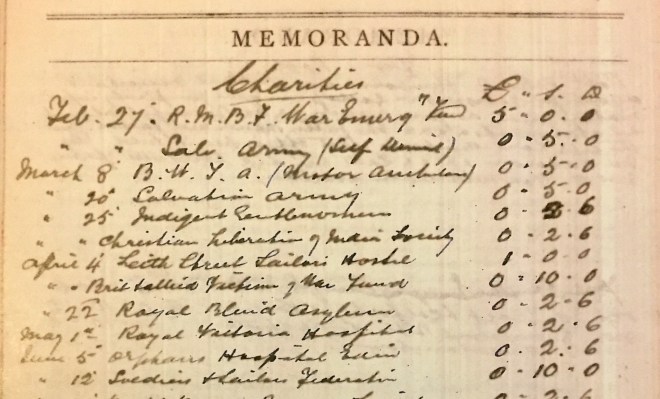
2 The Royal Medical Benevolent Fund (RMBF) – see also the second illustration which shows Dr Muir’s separate list of charitable giving

The RMBF was founded as the Medical Benevolent Fund in 1836 by members of the Provincial Medical and Surgical Association, which itself later became the British Medical Association. From the outset the RMBF was non-contributory and all funds were donated. All practitioners were eligible for assistance irrespective of whether they had ever paid money in to the charity and regardless of whether or not they were a member of the Provincial Medical and Surgical Association. In the nineteenth century, beneficiaries of the RMBF tended to fall into three categories. First, elderly or frail doctors were supported as their ability to earn a living declined. Second, widows of medical men were provided with money to live independently (and so avoid the need to apply for other charities or, worse still, register for poor relief). Third, orphans of medical men were assisted, but this element of the charity had a surprising feature: the majority of the orphans were adult women, rather than children. The charity was recognising the limited opportunities for women in Victorian England. Unmarried daughters of doctors had few careers open to them, and none that allowed women to earn very much. If medical fathers failed to leave savings, a legacy or annuity for their womenfolk, these adult orphans could find themselves impoverished, in a world without a welfare state or a pension system. Widows and orphans formed by far the largest group of beneficiaries of the RMBF towards the end of the Victorian era. In the 1880s, 90 percent of grants were made in these categories. The fund received its ‘Royal’ prefix in 1912 and employed staff from 1915; up to that point, it had been run entirely voluntarily. But the onset of war posed new problems and the Fund developed new ways to assist beleaguered practitioners. In 1915 a War Emergency Fund was set up to help medical families in temporary straits due to the war, and by the time of its closure in 1928 it had distributed over thirty-five thousand pounds. [Source: https://rmbf.org/about/our-history/ accessed 2019.03.01]
[Source: Scottish Borders Archives & Local History Service SBA/657/22, Dr J S Muir of Selkirk, medical practitioner, journal for 1919]

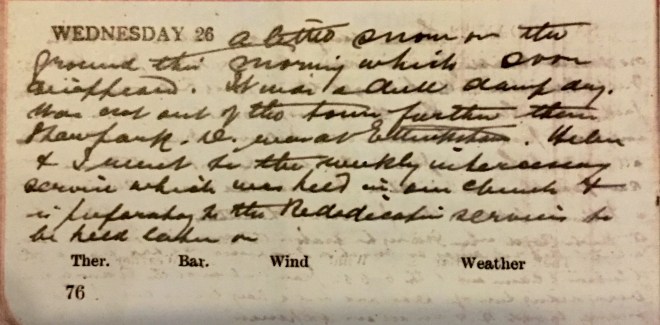
26 February 1919 diary of Dr John Stewart Muir (1845-1938) of Selkirk

A little snow on the ground this morning which soon disappeared. It was a dull damp day. Was not out of the town further than Shawpark. D [Dr David Graham] was at Ettrickshaws. Helen [Muir] + I went to the weekly intercessory service which was held in our church + is preparatory to the Rededication services to be held later on.

[Source: Scottish Borders Archives & Local History Service SBA/657/22, Dr J S Muir of Selkirk, medical practitioner, journal for 1919]
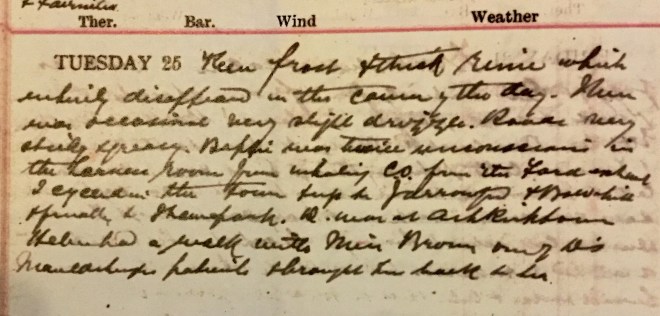
25 February 1919 diary of Dr John Stewart Muir (1845-1938) of Selkirk

Keen frost + thick rime1 which entirely disappeared in the course of the day. There was occasional very slight drizzle. Roads very sticky + greasy. Baptie was twice unconscious in the harness room from inhaling CO [Carbon monoxide] from the Ford exhaust. I cycled in the Town + up to Yarrowford + Bowhill + finally to Shawpark. D [Dr David Graham] was at Ashkirktown. Helen [Muir] had a walk with Miss Brown, one of D.’s Mauldsheugh patients + brought her back to tea.

1 Rime has good credentials in the south of Scotland c.f. ‘Dictionar o the Scots Leid’ “Rime, n., v. Also rhyme, rim. [rəim] I. n. 1. Hoar-frost (Peb. 1802 C. Findlater Agric. Peb. 6; Mry. 1925; Dmf. 1925 Trans. Dmf. and Gall. Antiq. Soc. XIII. 36; Cai. 1931). Gen.Sc. Also in Eng. dial. Also attrib. in comb. rim-frost, id. (Sc. 1710 T. Ruddiman Gl. to Douglas Aeneis) and fig. Deriv. rimie, frosty. Gen.Sc.Rxb.  1808  A Scott Poems 95: Nae rime this year amang the corn Did mar the kindly reapin morn.”

[Source: Scottish Borders Archives & Local History Service SBA/657/22, Dr J S Muir of Selkirk, medical practitioner, journal for 1919]

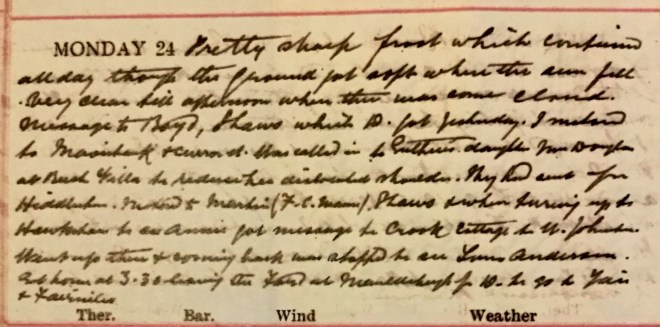
24 February 1919 diary of Dr John Stewart Muir (1845-1938) of Selkirk

Pretty sharp frost which continued all day though the ground got soft where the sun fell. Sky clear till afternoon when there was some cloud. Message to Boyd, Shaws which D [Dr David Graham] got yesterday. I motored to Mavisbank + Curror Street. Was called in to Guthrie’s [?] daughter Mrs Douglas at Bush Villa [?] to reduce her dislocated shoulder. They had sent for Hiddleston 1. Motored to Martin (F.C. Manse), Shaws + when turning up to Hawkshaw to see Annie2 got message to Crook Cottage to W Johnstone. Went up there + coming back was stopped to see James Anderson. Got home at 3.30 leaving the Ford at Mauldsheugh for D. to go to Yair + Fairnilee.

1 John Murray Hiddleston (1891-1954), medical practitioner

2 Ann Helen ‘Annie’ Little (1894-1968), of Hawkshaw, Kirkhope, Selkirkshire, Dr Muir’s servant for 6½ years until early 1918 when she left go to Moffat Hydro Military Hospital on V.A.D. work

[Source: Scottish Borders Archives & Local History Service SBA/657/22, Dr J S Muir of Selkirk, medical practitioner, journal for 1919]

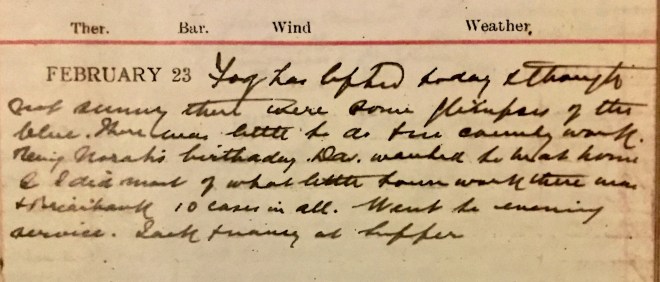
23 February 1919 diary of Dr John Stewart Muir (1845-1938) of Selkirk

Fog has lifted today + although not sunny there were glimpses of the blue. There was little to do + no County work. Being Norah’s birthday Dav. [Dr Graham] wanted to be at home1 + I did most of what little town work there was + Briarbank 10 cases in all. Went to evening service. Jack + Nancy at supper2.

1 Norah Campion Graham née West (1887-1971) and her husband (and Dr Muir’s co-partner) Dr David Charteris ‘Dav.’ Graham (1889-1963), medical practitioner

2 John Roberts junior ‘Jack’ (1876-1966); mill owner and Provost of Selkirk, later knighted “for political and public services in Selkirkshire” [Supplement to the London Gazette 1 June 1953 page 2941] and his wife Agnes Amelia ‘Nancy’ Roberts née Muir (1878-1948), Dr Muir’s second daughter

[Source: Scottish Borders Archives & Local History Service SBA/657/22, Dr J S Muir of Selkirk, medical practitioner, journal for 1919]