28 June 1920 diary of Dr John Stewart Muir (1845-1938) of Selkirk

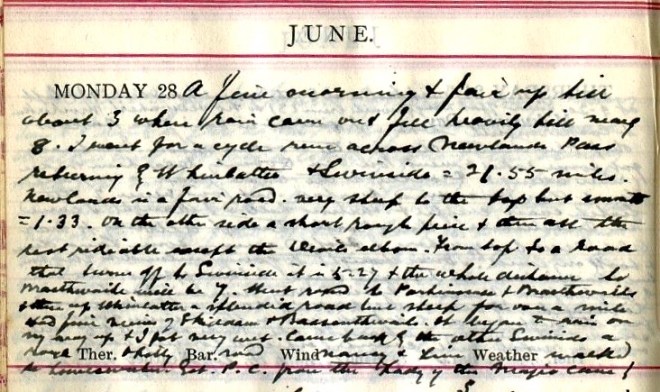
A fine morning + fair up till about 3 when rain came on + fell heavily till nearly 8. I went for a cycle run across Newlands Pass returning by Whinlatter + Swinside = 21.55 miles1. Newlands is a fair road, very steep to the top but summit = 1.33. On the other side a short rough piece + then all the rest rideable except the Devil’s Elbow2. From top to a road that turns off to Swinside it is 5.27 + the whole distance to Braithwaite will be 7. Went round to Portinscale + Braithwaite + then up Whinlatter, a splendid road but steep for over a mile. Had fine views of Skiddaw3 + Bassenthwaite. It began to rain on my way up + I got very wet. Came back by the other Swinside, a rough + hilly road. Nancy + Tim4 walked to Loweswater. Got P.C. [postcard] from the Lady of the Magic Cave!5

1 Dr Muir went up the Newlands Pass, ascending straight out of Buttermere and dropping into Newlands Valley from whence he cycled to Portinscale and Braithwaite – without diverting to Swinside (grid reference NGR NY242,217) – before ascending the Whinlatter Pass from Braithwaite and returning to Buttermere via Swinside (NY169,246) and Hopebeck (NY163,239)

2 The Devil’s Elbow is the awkward hairpin where the Buttermere – Newlands road crosses Ill Gill adjacent to Keskadale Farm, grid reference NGR NY210,193 and is visible (though not named) on the Ordance Survey 6″ Cumberland Sheet LXIII.SE, published 1900; it would have been one of the last tricky features for the Keswick – Borrowdale – Buttermere – Keswick horse-drawn coach tours noted in Dr Muir’s diary entry of 22 June 1920

3 Dr Muir’s best viewpoint across the valley to Skiddaw was probably above Lanefoot Farm on the ascent of Whinlatter, at grid reference NY223,244

4 Agnes Amelia ‘Nancy’ Roberts née Muir (1878-1948) and George Edward ‘Tim’ Roberts (1911-2005), Dr Muir’s daughter and youngest grandson

5 Agnes Mackintosh, née Watson, formerly Harper (1859-1946), of Elm Park, Selkirk, the house previously referred to by Dr Muir as ‘the Magic Cave’ on account of Mrs Mackintosh’s generosity with gifts of food and drink
[Source: Scottish Borders Archives & Local History Service SBA/657/23, Dr J S Muir of Selkirk, medical practitioner, journal for 1920]
27 June 1920 diary of Dr John Stewart Muir (1845-1938) of Selkirk

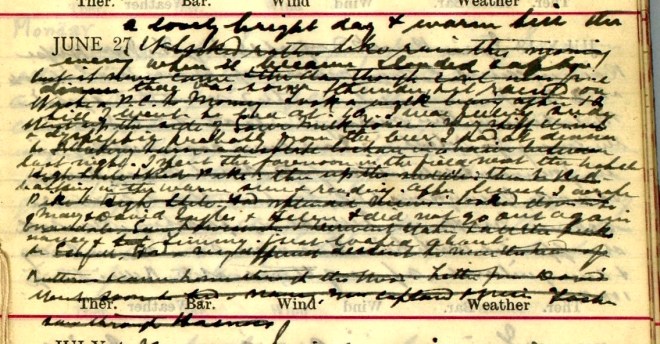
A lovely bright day + warm till the evening when it became clouded + after dinner there was some thunder + it rained on till I went to bed at 10. I was feeling seedy + dyspeptic probably from the beer I had at dinner last night. I spent the forenoon in the field next the hotel basking in the warm sun + reading. After lunch I wrote May [Lindsay1] + David Ingles2 + Helen + did not go out again. Nancy + Timmy3 just loafing about.

1 If the reading is correct this may be Marion Vassie ‘May’ Lindsay (1886-?1940), sometime V.A.D. and originally from Whitehope, Yarrow

2 David Nicholson Ingles (1888-1933), A.R.H.A., portrait artist, married in 1920 at Selkirk and painting a portrait of Dr Muir, the whereabouts of which the Editor cannot discover

3 Agnes Amelia ‘Nancy’ Roberts née Muir (1878-1948) and George Edward ‘Tim’ Roberts (1911-2005), Dr Muir’s daughter and youngest grandson

[Source: Scottish Borders Archives & Local History Service SBA/657/23, Dr J S Muir of Selkirk, medical practitioner, journal for 1920]
26 June 1920 diary of Dr John Stewart Muir (1845-1938) of Selkirk

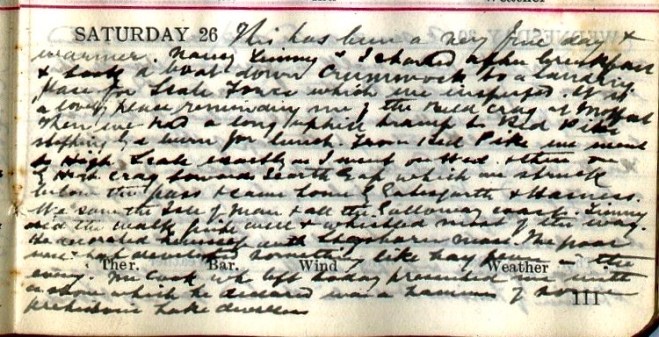
This has been a very fine day + warmer. Nancy, Timmy1 + I started after breakfast + took a boat down Crummock [Water] to a landing place for Scale Force2 which we inspected. It is a lovely place reminding me of the Bald [?] Crag at Moffat3. Then we had a long uphill tramp to Red Pike, stopping by a burn for lunch. From Red Pike we went by High Stile exactly as I went on Wed.4 + then on by High Crag towards Scarth Gap which we struck below the pass + came home by Gatesgarth + Hassness. We saw the Isle of Man + all the Galloway coast. Timmy did the walk quite well + whistled most of the way. He decorated himself with Stagshorn [?] Moss5. The poor man had developed something like hay fever in the evening! The cook who left today presented me with a stone which he declared was a hammer [?] of some prehistoric lake dweller.

1 Agnes Amelia ‘Nancy’ Roberts née Muir (1878-1948) and George Edward ‘Tim’ Roberts (1911-2005), Dr Muir’s daughter and youngest grandson

2 Scale Force is a high waterfall almost opposite Buttermere Village, tucked away behind Lingcomb Edge below Red Pike and falling 52 metres out of the combe below Little Dodd

3 The Editor would welcome information about this feature near Moffat, its name or location

4 Dr Muir, his daughter and grandson have walked the Red Pike – High Stile – High Crag ridge on the SSW side of Buttermere before apparently dropping off the ridge before the smaller peak called Seat to join the Scarth Gap to Warnscale path; if part of this route is the same as Dr Muir’s on the Wednesday then he must have walked further round Warnscale Bottom than was evident from his description of that day

5 If the Editor’s reading is correct then this is presumably common club moss or stag’s-horn clubmoss Lycopodium clavatum; its distribution makes this feasible [Source: The Botanical Society of Britain and Ireland Biological Records Centre ‘Online Atlas of the British and Irish Flora’ here]

[Source: Scottish Borders Archives & Local History Service SBA/657/23, Dr J S Muir of Selkirk, medical practitioner, journal for 1920]
25 June 1920 diary of Dr John Stewart Muir (1845-1938) of Selkirk

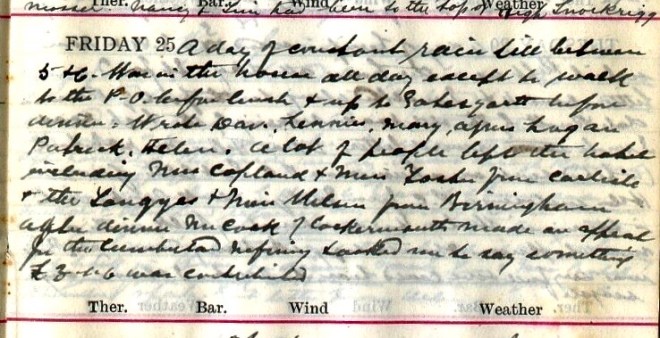
A day of constant rain till between 5 + 6. Was in the house all day except to walk to the P.O. before lunch + up to Gatesgarth1 before dinner. Wrote Dav. [Graham], Lennies [?], Mary, Agnes Lagan2 , Patrick3, [and] Helen4. A lot of people left the hotel including Mrs Copland5 [sic] + Miss Foster from Carlisle + the Longges + Mrs Wilson from Birmingham. After dinner Mr Cook of Cockermouth made an appeal for the Cumberland Infirmary6 + asked me to say something. £3 1 6 was contributed.

1 Gatesgarth is the Farm at the south west end of Buttermere at the bottom of Honister Pass and below Fleetwith Pike

2 Unidentified

3 Patrick Rodger Stewart ‘Pat’ Muir (1879-1961), Dr Muir’s only son, living in New Zealand since 1902

4 Helen Frances ‘Mousey’ Muir (1880-1963), Dr Muir’s third daughter and sometime housekeeper

5 Susanna Copeland née Foster, widow of the Reverend William Broadbent Copeland (c.1839-1904), M.A., vicar of St James Buttermere Parish 1898-1902 [Sources: his death, Mar 1904, Copeland, William, Whitehaven Registration District 10b 482 and marriage Sep 1862, Copeland, William Broadbent and Foster, Susanna, Islington 1b 473]

6 The Cumberland Infirmary, Carlisle

[Source: Scottish Borders Archives & Local History Service SBA/657/23, Dr J S Muir of Selkirk, medical practitioner, journal for 1920]
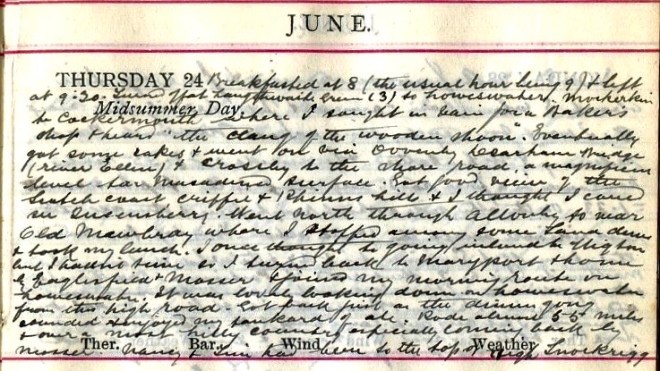
24 June 1920 diary of Dr John Stewart Muir (1845-1938) of Selkirk

Breakfasted at 8 (the usual hour being 9) + left at 9.30. Turned off at Longthwaite Green (3) to Loweswater, Mockerkin to Cockermouth1, I sought in vain for a baker’s shop + heard “the clang of the wooden shoon”2. Eventually got some cakes + went on via Dovenby3, Dearham Bridge (River Ellen) + Crossley4 to the shore road, a magnificent level tar Macadamed surface. Got good views of the Scotch coast + Criffel + Shinns Hills5 + I thought I could see Queensberry6. Went north through Allonby to near Old Mowbray7, where I stopped among some sand dunes + took my lunch. I once thought to going inland to Wigtown but I hadn’t time so I turned back to Maryport + home by Eaglesfield + Mosser8 + joined my morning route on Loweswater9. It was lovely looking down on Loweswater from the high road10. Got back just as the dinner gong sounded + enjoyed my tankard of ale. Rode about 55 miles + over the most hilly country, especially coming back by Mosser. Nancy + Tim11 had been to the top of High Snockrigg12.

1 Lanthwaite Green (grid reference NGR NY158,208) via Mockerkin (NY090,232) to Cockermouth is a diversion westwards from the direct route

2 ‘The Clang of the Wooden Shoon’, a song by James L Molloy (1837-1909), published by Metzler, 1875; referring of course to clog wearing, at one time the standard footwear in Cumberland and much of the rest of the north of England [Sources: Derek B Scott, ‘The Singing Bourgeois: Songs of the Victorian Drawing Room and Parlour’, Open University Press, 1989 and Daniel Scott, ‘Bygone Cumberland and Westmorland’, Andrews & Co., London 1899]

3 Dr Muir has gone north west from Cockermouth via Dovenby (grid reference NGR NY095,334) and Dearham Bridge (NY068,371) to the coast road

4 Crossley is presumably Crosby (NY071,383) though there is a Crossley near Maryport noted in John Brand and Sir Henry Ellis ‘Observations on Popular Antiquities: Chiefly Illustrating the Origin of our Vulgar Customs, Ceremonies and Superstitions’, Volume 2, London, 1841, page 93

5 Criffel (570m), Kirkcudbrightshire and the Rhinns of Kells, Dumfries and Galloway, the highest of which is Corserine (814m)

6 Queensberry (697m) in the Lowther Hills and ESE of Moffat

7 Allonby (NY081,429) and Mawbray, sometimes called Old Mawbray (NY087,466), the northern limit of Dr Muir’s cycle

8 Eaglesfield (NY094,281) and Mosser (NY115,250)

9 Dr Muir probably met the Loweswater road and his outward route at NY127,217 just before Crabtreebeck (NY130,215)

10 Dr Muir must have first seen Loweswater from about 230m height near Askill (NY121,228) before dropping across the steep contours of Darling Fell to meet the Loweswater road

11 Agnes Amelia ‘Nancy’ Roberts née Muir (1878-1948) and George Edward ‘Tim’ Roberts (1911-2005), Dr Muir’s daughter and youngest grandson

12 High Snockrigg (NY186,168), which Dr Muir may have ascended on 21 June

[Source: Scottish Borders Archives & Local History Service SBA/657/23, Dr J S Muir of Selkirk, medical practitioner, journal for 1920]
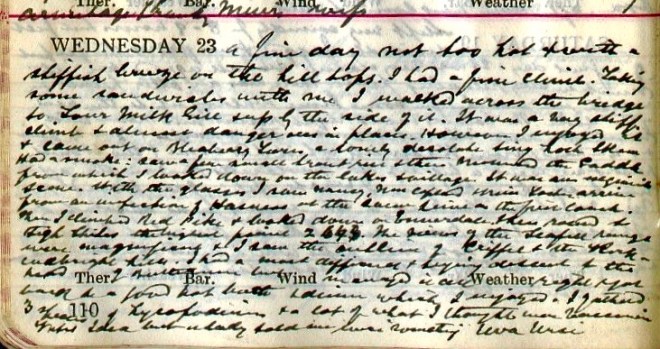
23 June 1920 diary of Dr John Stewart Muir (1845-1938) of Selkirk

A fine day, not too hot + with a stiffish breeze on the hill tops. I had a fine climb. Taking some sandwiches with me I walked across the bridge to Sour Milk Ghyll1 + up by the side of it. It was a very stiff climb + almost dangerous in places. However I enjoyed it + came out on Bleaberry Tarn2 a lonely desolate tiny Loch Skeen3. Had a smoke: saw a few small trout rise + then mounted the Saddle4 from which I looked down on the lakes + village. It was a magnificent scene. With the glasses I saw Nancy5, Mrs Copland6 + Miss Foster 7 arrive from an inspection of Hassness8 at the same time as the first coach. Then I climbed Red Pike9 + looked down on Ennerdale10, then round to High Stile11, the highest point 2,643. The views of the Scafell12 range were magnificent + I saw the outline of Criffel13 + the Kirkcudbrightshire hills14. I had a most difficult + trying descent to the head of Buttermere15 but managed it all right + got back to a good hot bath + dinner which I enjoyed. I gathered 3 spears of Lycopodium16 + a lot of what I thought was Vaccinium vitis idea17 [sic] but a lady told me it was “something” Uva ursi18.

1 Sourmilk Gill (grid reference NGR NY169,158) drops steeply and in a surprisingly straight line into the north west corner of Buttermere lake

2 Bleaberry Tarn (NY166,154) sits in a Corrie below Red Screes andHigh Pike and debouches into Sourmilk Gill

3 Loch Skene, above the Grey Mare’s Tail, Dumfries & Galloway, close to Birkhill and the Selkirkshire border (NT171,165); both are in very tight corries

4 Presumably The Saddle (between Red Pike and Dodd (NY163,156)

5 Agnes Amelia ‘Nancy’ Roberts née Muir (1878-1948), Dr Muir’s second daughter

6 Susanna Copeland née Foster, widow of the Reverend William Broadbent Copeland (c.1839-1904), vicar of St James Buttermere Parish 1898-1902 [Sources: his death, Mar 1904, Copeland, William, Whitehaven Registration District 10b 482 and their marriage Sep 1862, Copeland, William Broadbent and Foster, Susanna, Islington 1b 473]

7 Sister of Susanna Copeland née Foster – see previous footnote

8 Hassness, the property directly opposite Dr Muir across Buttermere Lake, a private home originally, later a walking centre run by the Ramblers’ Association and now owned by the R.A. and called Hassness Country House

9 Dr Muir has continued to Red Pike (755m) on the main ridge (NY160,154)

10 Ennerdale is the isolated valley south west of Dr Muir at this point

11 High Stile (806m), the next peak (NY167,147) on the ridge when travelling south east

12 Dr Muir will have seen the Scafell range to the SSE relatively close at hand, this being the great bulk of mountains above Wastwater including Scafell and Scafell Pike and a number of other high peaks

13 Criffel (569m), south of New Abbey, Dumfries & Galloway (NX957,618)

14 Dr Muir is looking NNE across the Solway Firth to the hills around Kirkcudbright

15 The obvious route to the head of Buttermere from High Stile is straight off the top, dropping for about 400m with Burtness Comb on one’s right, before crossing the contours across Comb Beck to reach the footbridge at Peggy’s Bridge (which is visible on the Ordnance Survey 6 inch Cumberland Sheet LXIX.SE, published 1900)

16Lycopodium is a genus of clubmosses; Natural England document Lycopodium clavatum in the Honister – Fleetwith Pike area [Citation for Site of Special Scientific Interest (SSSI) under Section 28 of the Wildlife and Countryside Act, 1981 for Honister Crag / Allerdale / Cumbria here

17 Vaccinium vitis-idaea a short evergreen shrub in the heath family

18 Almost certainly Arctostaphylos uva-ursi or Common bearberry

[Source: Scottish Borders Archives & Local History Service SBA/657/23, Dr J S Muir of Selkirk, medical practitioner, journal for 1920]
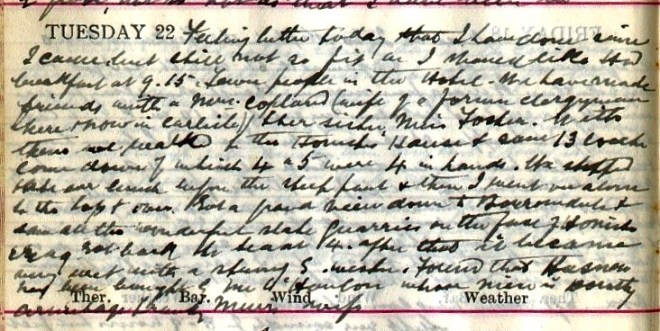
22 June 1920 diary of Dr John Stewart Muir (1845-1938) of Selkirk

Feeling better today than I have done since I came but not as fit as I should like. Had breakfast at 9.15. Fewer people in the Hotel. We have made friends with a Mrs Copland (wife of a former clergyman here + now in Carlisle) + her sister Miss Foster1. With them we walked to the Honister Hause + saw 13 coaches come down, of which 4 or 5 were 4 in hand2. We stopped + ate our lunch before the steep part + then I went on alone to the top + over3. Got a grand view down to Borrowdale + saw all the wonderful slate quarries on the face of Honister Crag. Got back to tea at 4. Found that Hassness4 has been bought by Mr O’Hanlon5 whose niece is Dorothy Armitage6, Frank Muir’s wife.

1 See diary entry for 20 June 1920

2 Pape’s Garages, Coaches and Motors, Ltd., Keswick was running coach and horse tours into the 1920s, traditionally running down Borrowdale, over the steep Honister Pass (1,167 feet and gradient 25%) and normally stopping at the Fish Inn, Buttermere before returning via Newlands Hause (1,093 feet); descending Honister was a fairly heroic undertaking – there are many postcards showing it and there is a description of a 20th Century tour in Christine Jennings’ ‘Robbie: The Life of Sir Robert Jennings’, Troubador Publishing, 2019, pp. 13-14

3 It appears Dr Muir climbed Fleetwith Pike from Honister Hause (if he had ascended Dale Head on the opposite side of the Hause he would have been looking down towards Newlands – and in any case it is the slate quarries on Honister Crags, part of Fleetwith Pike, that he climbed past) and at some point he took in the view towards Seatoller and Rosthwaite at the south end of Borrowdale

4 Hassness, a private home originally, later a walking centre run by the Ramblers’ Association (where the Editor was introduced to salted porridge and, aged 13, yomped the mountain circuit of Buttermere coloquially known as the Buttermere Buggerer); now owned by the R.A. and called Hassness Country House

5 In fact it was William Sydney O’Hanlon (1869-1940), son of William Patrick O’Hanlon (1838-1912) and Martha Hannah O’Hanlon née Ryder, who purchased Hassness about 1920; their neighbours at Bowden, Altrincham, William Armitage senior (c.1839-) and Margaret Petrie Armitage née Mills had a son John Basil Armitage (1876-1917) and a daughter Dorothy Armitage (1873-1943) who married respectively Alice Kathleen O’Hanlon (1880-1957), daughter of William O’Hanlon senior (above), and Dr Muir’s nephew Francis ‘Frank’ Muir (1877-1972), electrical engineer

6 Dorothy Armitage married Francis ‘Frank’ Muir, September Quarter 1909, at Bucklow Registration District [Lancashire / Cheshire] 8a 427

[Source: Scottish Borders Archives & Local History Service SBA/657/23, Dr J S Muir of Selkirk, medical practitioner, journal for 1920]
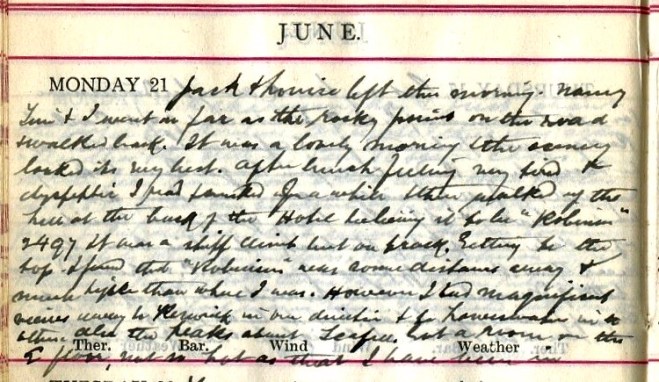
21 June 1920 diary of Dr John Stewart Muir (1845-1938) of Selkirk

Jack + Louise1 left this morning. Nancy, Tim2 + I went as far as the rocky point on the road + walked back. It was a lovely morning + the scenery looked its very best. After lunch feeling very tired + dyspeptic I read + smoked for a while + then walked up the hill at the back of the Hotel believing it to be “Robinson” 24973. It was a stiff climb but on [a] track. Getting to the top I found that “Robinson” was some distance away + much higher than where I was4. However I had magnificent views away to Keswick in one direction + to Loweswater in another. Also the peaks around Scafell. Got a room on the 2nd floor, not as hot as that I have been in5.

1 Louisa Jane ‘Louise’ Roberts (1906-1982), one of Dr Muir’s granddaughters

2 George Edward ‘Tim’ Roberts (1911-2005), one of Dr Muir’s grandsons

3 Robinson (737m) is the mountain at the Buttermere end of the Robinson – Hindscarth – Dale Head ridge running along the NNE side of Buttermere and Honister

4 Very probably High Snockrigg, grid reference NGR NY186,168, which best seems to fit the views that Dr Muir describes

5 On his arrival Dr Muir had complained about excessive heat in his hotel room

[Source: Scottish Borders Archives & Local History Service SBA/657/23, Dr J S Muir of Selkirk, medical practitioner, journal for 1920]
20 June 1920 diary of Dr John Stewart Muir (1845-1938) of Selkirk

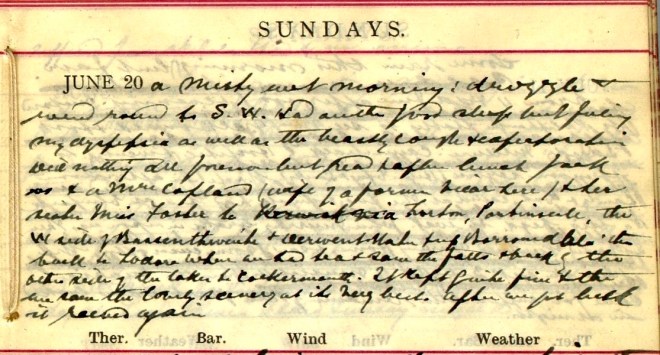
Misty wet morning: drizzle + wind to S.W. Had another good sleep but feeling my dyspepsia as well as the beastly cough + expectoration. Did nothing all forenoon but read + after lunch Jack, me + a Mrs Copland1 (wife of a former vicar here) + her sister Miss Foster [went] to Keswick via Lorton, Portinscale, the W. side of Bassenthwaite + Derwentwater2 + up Borrowdale then back to Lodore3 where we had tea + saw the falls + back by the other side of the lake to Cockermouth4. It kept quite fine + then [?] we saw the lovely scenery at its very best. After we got back it rained again.

1 Probably Susanna Copeland née Foster, widow of the Reverend William Broadbent Copeland (c.1839-1904), vicar of St James Buttermere Parish 1898-1902 [Sources: his death, Mar 1904, Copeland, William, Whitehaven Registration District 10b 482 and marriage Sep 1862, Copeland, William Broadbent and Foster, Susanna, Islington 1b 473]

2 The party has run more or less due north to Low Lorton and, continuing, has taken one of the roads to the north of Ling Fell passing Bassenthwaite Lake on its west side to Portinscale just outwith Keswick and from there has run down the west side of Derwent Water, probably joining the main road along Borrowdale at Grange

3 A public house since at least 1795 and an hotel from the 19th Century, the Lowdore Hotel, called the Lodore Swiss Hotel from 1947-1999 but now the Lodore Falls Hotel, sits between the Lodore Falls and Derwent Water [Source: Lake District Hotels ‘The History of the Lodore Falls Hotel’ here]

4 They have returned via the main Borrowdale – Keswick road and reached Cockermouth via the east side of Bassenthwaite Lake

[Source: Scottish Borders Archives & Local History Service SBA/657/23, Dr J S Muir of Selkirk, medical practitioner, journal for 1920]

19 June 1920 diary of Dr John Stewart Muir (1845-1938) of Selkirk

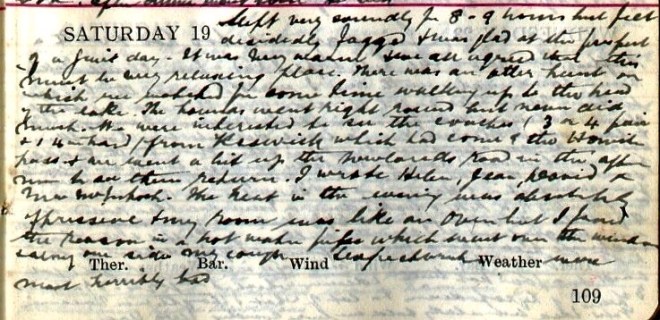
Slept very soundly for 8-9 hours but felt decidedly fagged + was glad at the prospect of a quiet day. It was very warm + we all agreed that this must be my relaxing place. There was an otter hunt on, which we watched for some time, walking up to the head of the lake. The hounds went right round but never did much. We were interested to see the coaches (3 or 4 pair + 14 in hand) from Keswick which had come by the Honister Pass1 + we went a bit up the Newlands road in the afternoon to see them return. I wrote Helen, Jean [both Muir], David [Graham] + Mrs Mackintosh. The heat in the evening was absolutely oppressive + my room was like an oven but I found the reason is a hot water pipe which went over + along one side. My cough + expectorating were most horribly bad.

1 Pape’s Garages, Coaches and Motors, Ltd., Keswick was running coach and horse tours into the 1920s, traditionally running down Borrowdale, over the steep Honister Pass (1,167 feet and gradient 25%) and normally stopping at the Fish Inn, Buttermere before returning via Newlands Hause (1,093 feet); descending Honister was a fairly heroic undertaking – there are many postcards showing it and there is a description of a 20th Century tour in Christine Jennings’ ‘Robbie: The Life of Sir Robert Jennings’, Troubador Publishing, 2019, pp. 13-14

[Source: Scottish Borders Archives & Local History Service SBA/657/23, Dr J S Muir of Selkirk, medical practitioner, journal for 1920]